

Curcumin, the key bioactive compound in turmeric, has garnered substantial scientific interest for its broad health benefits. Although its benefits have been recognised for centuries, curcumin’s poor natural absorption has long limited its clinical use. That changed with the development of enhanced formulations like BCM95, a patented blend of curcumin and turmeric essential oils designed to boost bioavailability. Human studies have shown that BCM95 offers up to seven times greater absorption than standard curcumin when taken orally. Thanks to this improved delivery, curcumin’s therapeutic effects are now being confirmed in clinical trials involving cancer, inflammatory diseases and even psychiatric disorders.
1. Anticancer Effects
The anticancer potential of curcumin is well-documented, with thousands of scientific studies highlighting its effects across various cancer types. Its two most prominent anticancer actions are the ability to trigger apoptosis (i.e., programmed cell death that helps eliminate abnormal cells) and to suppress NF-κB (i.e., an inflammation-driven cancer growth pathway). Curcumin also interferes with hormone-sensitive cancers by blocking HER2 (human epidermal growth factor receptor 2) and androgen receptors in breast and prostate cancer cells, respectively.
Clinical trials have also reinforced these findings. In prostate cancer patients, oral curcumin supplementation significantly lowered prostate-specific antigen (PSA) levels, a key biomarker of cancer activity. Other clinical trials have reported that curcumin can dampen the side effects of radiotherapy, such as dermatitis in breast cancer and urinary complications in prostate cancer patients (Figure 1). These results suggest that curcumin, especially in enhanced formulations like BCM95, may help slow cancer progression, reduce therapy-related complications and, ultimately, improve patient outcomes.
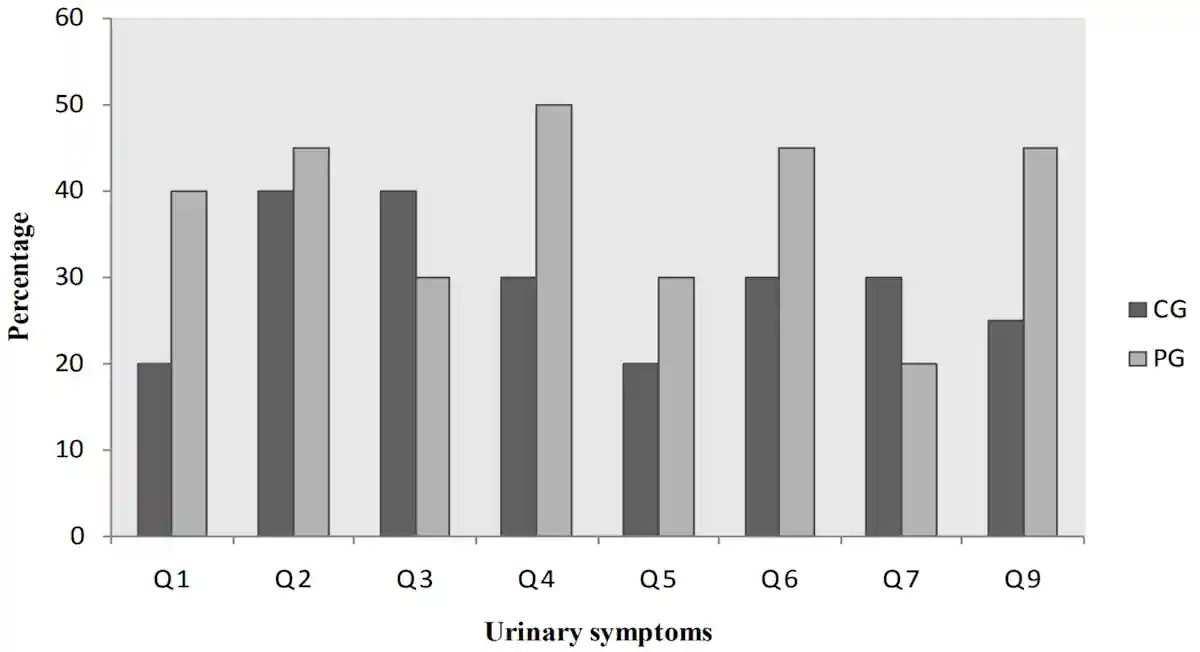
Figure 1. Percentage of men reporting worsening urinary symptoms three months after radiotherapy, comparing the curcumin group (CG) with the placebo group (PG). Each Q number corresponds to a specific symptom (Q1: frequent daytime urination; Q2: frequent night-time urination; Q3: toilet urgency; Q4: sleep disruption from night-time urination; Q5: difficulty going out due to urgent urination; Q6: unintentional urine leakage; Q7: pain when urinating; Q9: limitations in daily activities due to urinary problems. Across most symptoms, fewer men in the curcumin group (CG) experienced worsening, suggesting a protective effect against radiotherapy-related urinary side effects. Source: Hejazi et al. (2013), Journal of Cancer Science & Therapy.
2. Broad Anti-inflammatory Protection
Moreover, curcumin is widely appreciated for its powerful anti-inflammatory properties, which underlie many of its therapeutic benefits. After all, chronic inflammation is a key driver of disease because it causes continuous tissue damage and disrupts normal cellular functions. Curcumin helps counter this by modulating NF-κB, a major signalling pathway that governs inflammatory responses (Figure 2).
In fact, multiple meta-analyses of clinical trials have supported the efficacy of curcumin or BCM95 in improving clinical outcomes for patients with inflammatory conditions, such as type 2 diabetes, liver diseases, ulcerative colitis, heart diseases, osteoarthritis and metabolic syndrome. The benefits observed in these trials include reduced symptom severity and lower levels of circulating pro-inflammatory markers. Even in healthy individuals, meta-analyses have shown that curcumin significantly improves biomarkers of inflammation, oxidative stress and metabolic health (e.g., lipid profile and cardiovascular risk markers). Meta-analyses are considered the highest level of clinical evidence because they systematically synthesise data from multiple studies to derive a consensus result. Strong evidence, therefore, supports the broad anti-inflammatory protection of curcumin in both disease treatment and preventive health.
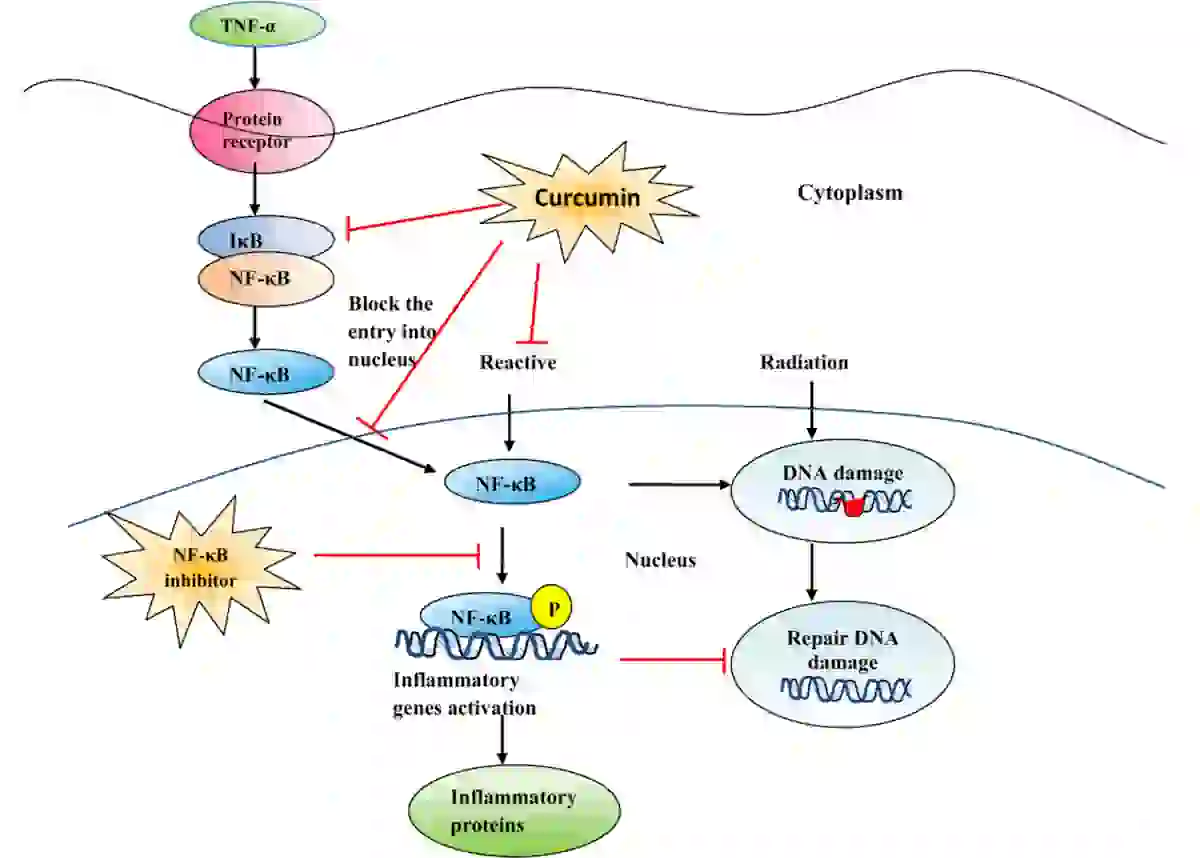
Figure 2. How curcumin interrupts the NF-κB signalling pathway, a major trigger of inflammation. Normally, inflammatory signals like TNF-α activate NF-κB, allowing it to enter the cell’s nucleus and switch on genes that produce inflammatory proteins. Curcumin stops NF-κB at multiple steps by blocking its activation, preventing its entry into the nucleus, and reducing its ability to bind DNA. As a result, fewer inflammatory genes are turned on. Abbreviations: NF-κB: Nuclear factor kappa-light-chain-enhancer of activated B cells; TNF-α: Tumour necrosis factor-alpha. Source: Rafiq et al. (2018), Journal of Biosciences and Medicines.
3. Promising Neuroprotective Capacity
Interestingly, curcumin is capable of crossing the blood-brain barrier, allowing it to exert anti-inflammatory effects in the brain as well. This is a valuable trait because neurons are particularly vulnerable to inflammation-related damage compared to other cell types. As a result, neuroinflammation has been implicated in numerous brain disorders, including Alzheimer’s dementia, stroke and even psychiatric disorders.
Beyond reducing neuroinflammation, curcumin may also influence brain chemistry by modulating neurotransmitters such as dopamine and serotonin, which are involved in mood regulation. Specifically, curcumin can inhibit the activity of monoamine oxidase (MAO), an enzyme that breaks down these neurotransmitters. Notably, MAO activity is often elevated in individuals with mood disorders, leading to reduced levels of serotonin and dopamine. By curbing MAO hyperactivity, curcumin thus helps maintain healthier neurotransmitter levels in the brain. As follows, emerging clinical trials have reported that curcumin reduces symptom severity in patients with major depressive and anxiety disorders. Overall, with its diverse therapeutic applications in psychiatry, inflammatory conditions and oncology, curcumin continues to be a versatile plant compound for overall health.